
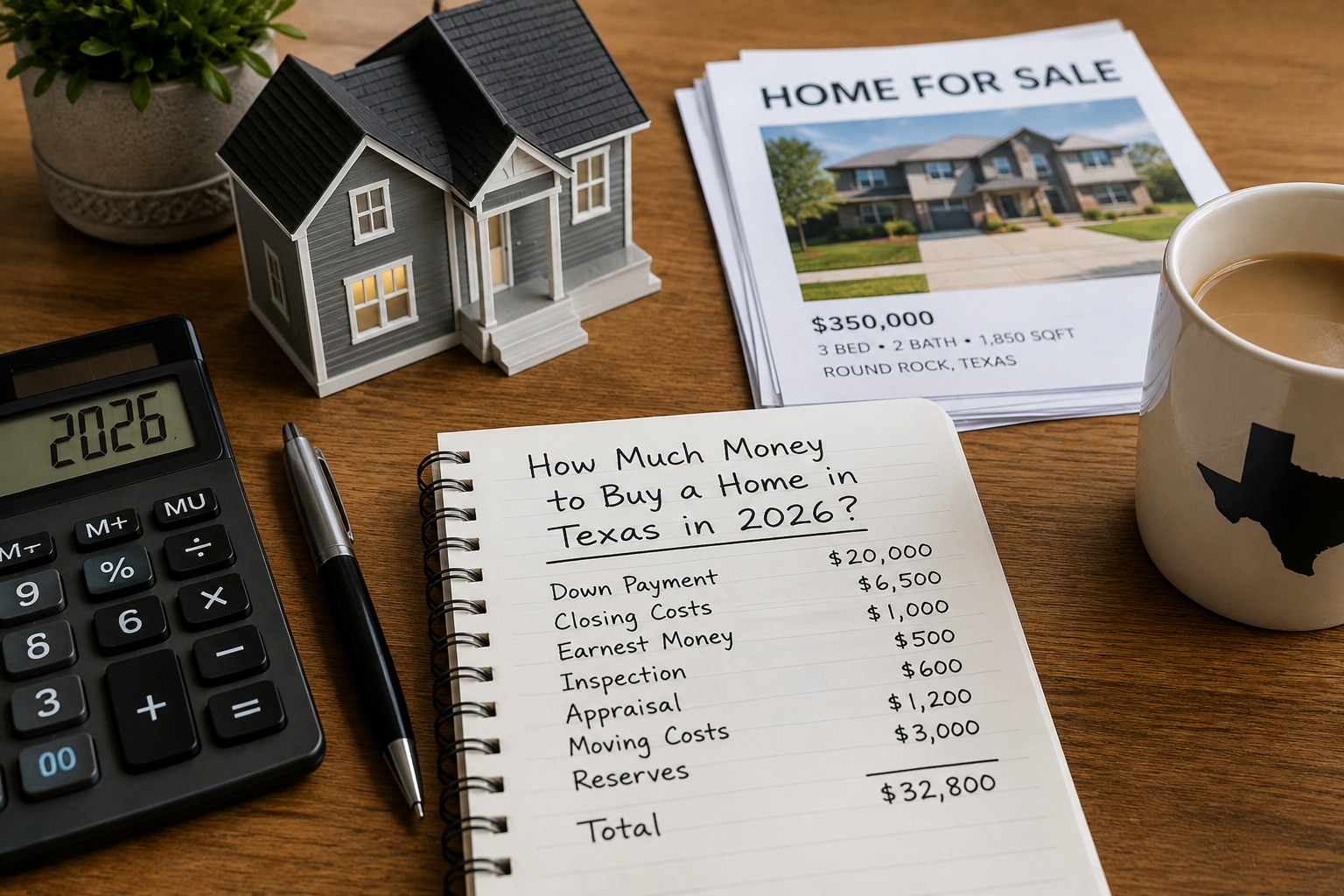
How Much Money Do You Need to Buy a Home in Texas in 2026?
One of the most common questions buyers ask is: “How much money do I actually need to buy a home?” The honest answer is that it depends on your loan program, your credit profile and what you negotiate. But the categories are always the same. Here is the full breakdown for Texas in 2026.
The short version
- Down payments range from 0% to 20%+ depending on the loan program you qualify for.
- Closing costs in Texas typically run 2%–5% of the purchase price.
- Texas contracts add two line items most buyers don’t expect: earnest money and the option fee.
- Two buyers purchasing the same house can need very different amounts of cash to close.
1. Down Payment
The required down payment varies depending on:
- Loan program
- Credit profile
- Lender guidelines
- Property type
- Occupancy type (primary residence, second home, or investment property)
Common loan structures at a glance
| Loan type | Typical minimum down | Often used by |
|---|---|---|
| Conventional | As low as 3% for qualified applicants | Buyers with stronger credit profiles |
| FHA | Typically 3.5% for qualified applicants | Buyers wanting more flexible guidelines |
| VA | 0% down for eligible borrowers | Eligible service members and veterans |
| USDA | 0% down for eligible borrowers | Buyers in designated eligible areas |
Actual requirements vary by lender and borrower qualifications.
Example on a $300,000 home (illustration only)
- 3% down = $9,000
- 3.5% down = $10,500
- 10% down = $30,000
- 20% down = $60,000
2. Closing Costs
In Texas, buyers typically pay approximately 2%–5% of the purchase price in closing costs.
These may include:
- Lender fees
- Title fees
- Appraisal
- Prepaid property taxes
- Homeowners insurance
- Escrow funding
On a $300,000 home, estimated closing costs may range from $6,000 to $15,000.
Worth knowing
Closing costs may sometimes be negotiated between parties depending on the terms of the contract and current market conditions. Seller-paid closing costs and lender credits are two of the most common ways buyers reduce cash needed at the table, though availability depends entirely on the deal and the market.
3. Texas Contract-Specific Costs
This is the part that surprises buyers relocating from other states. Texas real estate contracts commonly include:
- Earnest Money. Often around 1% of the purchase price, though negotiable. Delivered to the title company shortly after the contract is executed.
- Option Fee. A negotiable amount paid for the right to terminate during the option period. Delivered to the seller.
Earnest money is generally applied toward the buyer’s funds at closing if the transaction proceeds according to contract terms.
4. Additional Costs to Plan For
- Home inspection fees
- Survey (if required)
- Moving expenses
- Utility setup fees
- Maintenance or repairs after closing
When Is Each Cost Actually Due?
Buyers often assume every dollar is needed on day one. It isn’t. Here is the general order in a typical Texas transaction:
| Stage | What’s typically due |
|---|---|
| Days 1 to 3 after contract | Option fee and earnest money |
| During the option period | Inspection fees, paid directly to the inspector |
| Early in the contract period | Appraisal fee, if your lender collects it upfront |
| At closing | Balance of down payment, remaining closing costs and prepaids. Earnest money is credited back. |
| After closing | Moving, utility deposits, immediate repairs or updates |
Timelines and amounts vary by contract, lender and title company.
What Does Not Count Toward Your Down Payment
A frequent point of confusion. These are separate from your down payment, not part of it:
- Your option fee, which is paid to the seller and not applied to the loan
- Your inspection fee, paid out of pocket to a third party
- Closing costs and prepaid escrow items, which sit on top of the down payment
- Moving and post-closing expenses
Five Ways Buyers Reduce Cash to Close
If the number in front of you feels out of reach, it’s worth knowing that the total is more flexible than most buyers assume. These are the levers that come up most often. Not all will apply to your situation, and each depends on your loan program, the property and what the seller agrees to.
- Seller concessions. A negotiated contribution toward your closing costs. Loan programs cap how much a seller may contribute, so confirm the limit with your lender before you write the offer.
- Lender credits. Some lenders offer a credit toward closing costs in exchange for a slightly higher rate. Whether that trade makes sense depends on how long you plan to stay in the home.
- Down payment assistance. Programs exist at the state and local level, each with its own eligibility rules, income limits and funding availability. A licensed lender or housing agency can tell you what you qualify for.
- Gift funds. Many programs allow gifts from eligible sources toward down payment and closing costs, with documentation requirements. Talk to your lender before any money moves.
- Negotiating the option fee and earnest money. Both amounts are negotiable. In some situations a smaller option fee or a structured earnest money deposit can ease the upfront burden, though it may also affect how your offer is received.
The right combination depends on your loan, the property and the market you’re competing in. This is exactly the kind of thing worth mapping out before you start touring rather than after you’ve found a home you love.
The Mistake I See Most Often
Buyers save carefully for the down payment and stop there. Then the option fee, the inspection and the appraisal arrive in the first two weeks, and suddenly the reserve is thinner than expected.
A better approach is to plan for three separate pools of money: the upfront costs in the first two weeks, the cash due at closing, and a reserve for after you move in. That last one matters more than people expect. New homeowners almost always spend money in the first ninety days, whether on a repair, a replacement appliance, or simply blinds and a lawn mower.
Arriving at closing with nothing left is technically a successful purchase. It just isn’t a comfortable one.
What Impacts How Much You’ll Need?
Each buyer’s financial profile is unique. Lenders typically evaluate:
- Credit history
- Debt-to-income ratio
- Income and employment verification
- Cash reserves
- Loan type and interest rate
- Property type
Two buyers purchasing the same home may have different cash-to-close requirements based on their financial qualifications.
Buyer Assistance Programs in Texas
There are programs available that may help reduce upfront costs for eligible applicants. These may include:
- Down payment assistance programs
- First-time homebuyer programs
- State or local housing assistance programs
- Mortgage credit certificate programs
Program availability, qualification standards, income limits, geographic restrictions, and funding availability vary. Buyers should consult directly with a licensed lender or housing agency to determine eligibility.
General Savings Expectations
In many Texas markets in 2026, buyers may need anywhere from approximately $10,000 to $25,000+ for entry-level price points.
Higher purchase prices may require additional funds depending on loan structure and negotiated terms. These figures are estimates for educational purposes only and do not constitute financial advice.
Frequently Asked Questions
Do I really need 20% down to buy in Texas?
No. That is one of the most persistent myths in real estate. Several loan programs allow far less, and some allow 0% for eligible borrowers. Twenty percent down avoids mortgage insurance on conventional loans, which is a real benefit, but it is not a requirement to buy.
Is earnest money the same as a down payment?
No. Earnest money is a good-faith deposit held by the title company. If the transaction closes according to contract terms, it is generally credited toward your funds at closing, so it reduces what you bring on closing day rather than adding to it.
Can I get the seller to pay my closing costs?
Sometimes. Seller concessions are negotiable and depend on the property, the market and the strength of your offer. Loan programs also cap how much a seller is allowed to contribute. It is worth discussing before you write an offer, not after.
Can gift funds be used?
Many loan programs allow gift funds toward down payment and closing costs, with documentation requirements around sourcing and a gift letter. Rules vary by program, so confirm with your lender before any money moves.
What happens to my option fee if I buy the house?
Whether the option fee is credited at closing depends on how the contract is written. Unlike earnest money, it is not automatically applied in every case. Ask before you sign so there are no surprises on the settlement statement.
How soon before buying should I stop moving money around?
As early as possible. Lenders verify the source of your funds, and large or unexplained deposits create documentation work that can slow things down. If money needs to move, do it before you apply, and keep records of where it came from.
Keep reading
- What Is a Mortgage Pre-Approval and Why Houston Home Buyers Need One First
- What Every Texas Buyer Should Know Before Touring Their First Home
- The Buyer’s Guide, covering every milestone from start to close
Want a number that’s actually yours?
If you would like a personalized estimate based on your financial situation and current Texas market conditions, I am happy to connect you with trusted lending professionals and guide you through the process step-by-step.
All information provided is for general informational purposes only and should not be considered legal, tax, or financial advice. Loan programs, rates, down payment requirements, assistance availability, and closing costs vary by lender, borrower qualifications, and market conditions. Equal Housing Opportunity. All buyers are encouraged to consult with a licensed mortgage professional and conduct independent due diligence.
FROM OUR BLOG


Buying a Home With a Well & Septic System in Texas
North Houston Property Guidance Buying or Selling a Home With a Well or Septic System in Texas What these systems do, why properties have them, and the due diligence that helps protect buyers and sellers A private well or septic system is not automatically a problem and it should not automatically b

Buying or Selling a Home With a Well or Septic System in Texas
Some of the most important parts of a property are not visible when you walk through the front door.Homes on acreage, in unincorporated areas, and in some established communities may rely on a private well, septic system, or both. These systems are common in parts of Magnolia, Montgomery, Conroe, To

What Is My Houston-Area Home Worth?
How Do I Know What My Houston-Area Home Is Actually Worth? What Houston-area sellers should know about comparable sales, competition, condition and pricing Two homes can be only a few streets apart and still have very different values. Across Houston, Spring, Tomball, Cypress, Magnolia, Klein, The W
Results That Speak for Themselves
NateKruedelbach

bagita29
9211th